
Reframing how we think about public services
In The Liberated Method, Mark Smith, Visiting Professor of Public Service Innovation at Manchester Metropolitan University (UK) offers a radical rethink of how services help people who need support. Following conversations with Mark, we have adapted his work to help reflect these dynamics within child protection and human services systems.
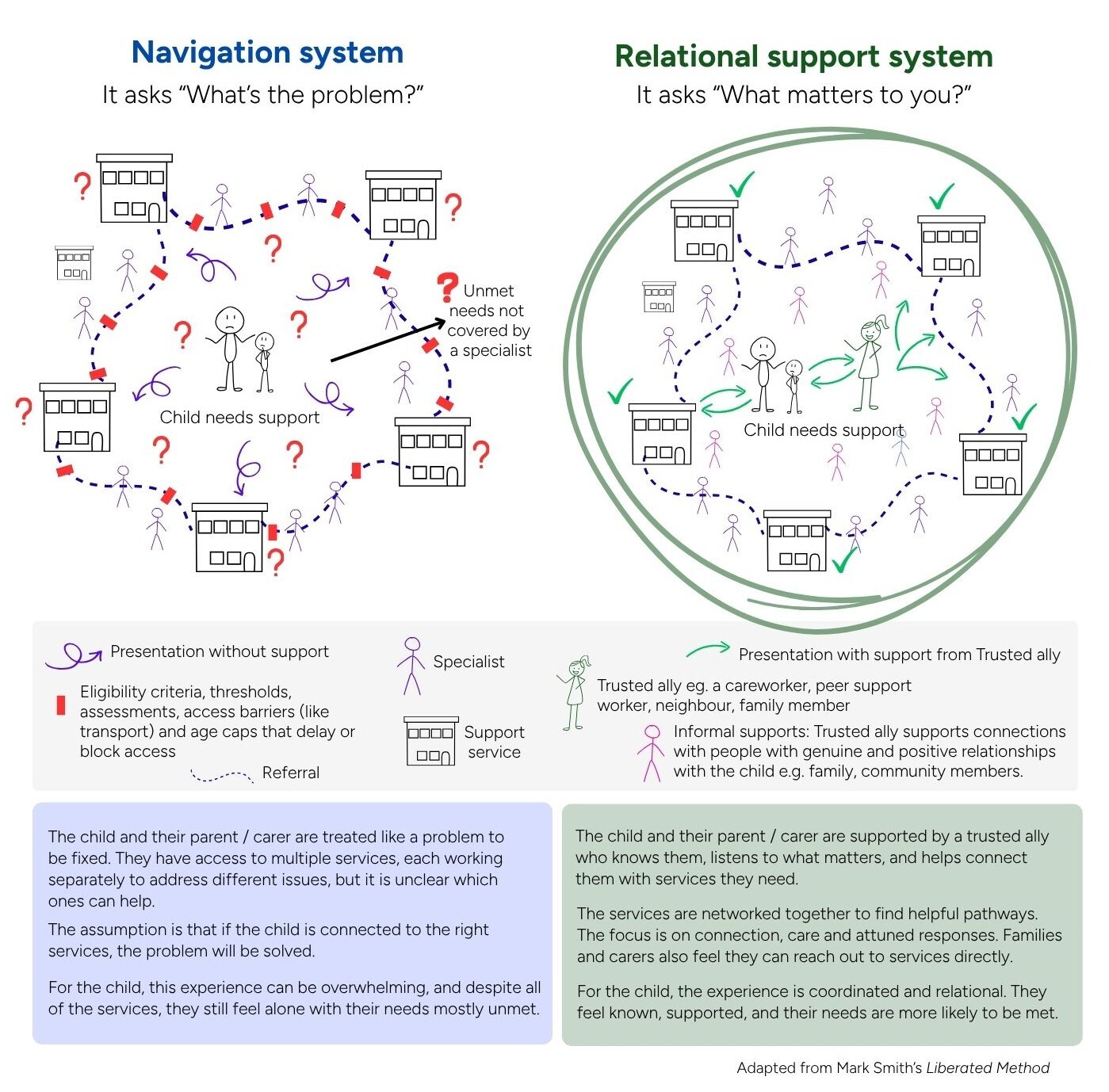
What Mark describes as the ‘Navigation System’ view is a familiar reality. Parents and families are often left to navigate a fragmented system of disconnected programs, each with separate assessments, thresholds and eligibility criteria. The burden falls on them to move between services, trying to work out who can help, retelling their story and trying to fit their circumstances into the categories the system recognises.
The same dynamic can play out for children, families and carers in the child protection system. Behaviour support, mental health, education services, case management - each working to help, but often from separate lenses. The focus shifts to navigating services rather than understanding and responding to what’s happening in the child’s life.
Yet the things that most shape a child’s wellbeing rarely sit neatly within a single service category: being in secure environments, feeling safe with a carer, feeling connected to family, friends and culture, having trusted adults who understand them and are in their corner.
The ‘Relational Support’ view (Mark’s Liberated Method) is an alternative. With guidance from our Advisory Network, we have adapted this idea to show how a consistent, trusted relational support ally can walk alongside a child and the attuned adults caring for them. This person provides continuity, trust, and a single point of human connection - not just service coordination.
It begins with the genuine and open question “What matters to you?” that is not tied to a particular service or program. It opens up what is most important to the child, parent, family or carer, whether that is advice about health services, relieving financial pressures, feeling less alone in navigating support, wanting school to feel manageable, wanting to be settled, or simply wanting to feel understood.
The answer helps guide the right kind of support, shaped around the goals and needs of the child and their families and carers, rather than fitting them into pre-existing program criteria. Specialists remain essential but instead of sending them from service to service, specialist expertise is brought in around the relationship when it’s needed. As Mark’s work shows, this approach often surfaces issues that may otherwise be missed - like a parent’s fear of losing housing or a young person’s need to reconnect with extended family - unlocking earlier, more effective help and reducing downstream statutory intervention.
Often the supports that make the biggest difference are what Mark calls “gloriously ordinary”: someone who is trusted and consistently there to sit alongside a parent at a stressful meeting, helping a young person attend an appointment they are anxious about, or supporting a child and carer through a difficult moment. These relational moments are often not recognised through measures or funding yet can prevent escalation and reduce the need for more intensive intervention later.
The implications for child protection are significant. When the system is organised around separate specialisms, it can miss the relational things that can help a child settle, heal and thrive. The Liberated Method helps show that outcomes improve when systems reduce fragmentation and enable relationships that are sustained over time.
The Centre for Relational Care and the Possibility Partnership convened a roundtable with Mark Smith in 2025, bringing together senior government and policy leaders. Read a summary.
Find out more about the Liberated Method.