
Protection comes through connection
The neuroscience is clear: consistent, stable and positive relationships are essential for children who have experienced maltreatment. These relationships help them move beyond hypervigilance and begin to heal.
That’s why we’re calling for a shift to a Child Connection System – a relationships-first approach to supporting children and families that:
- is community-led
- reduces unnecessary bureaucracy
- is financially sustainable.
What’s wrong with the current Child Protection System?
Most people believe that governments can step in and care for vulnerable children, protect them and keep them safe. But this is a myth:
- The current child protection system paradoxically reduces children’s safety by disrupting the relationships that are essential to their wellbeing and resilience.
- Our institutions have forgotten the centrality of relationships. We’ve been careful about the needs of the system, but careless about relationships.
- Despite best intentions, a child protection system is designed to protect itself. Its purpose is to keep adults and institutions safe. Adding more paperwork doesn’t make kids safer. We are putting bureaucracy before our humanity.
- NSW’s $3.2 billion surveillance, investigation and removal system is "ineffective, inefficient and unsustainable", and "cannot demonstrate that it is meeting any of its core child protection responsibilities"*.
What a Child Connection System could look like
The visual brings together what we have been learning through research, sector conversations, and the experiences of young people, parents, families, carers and workers. It shows what a practical alternative to the current system could look like, with connection as its north star.
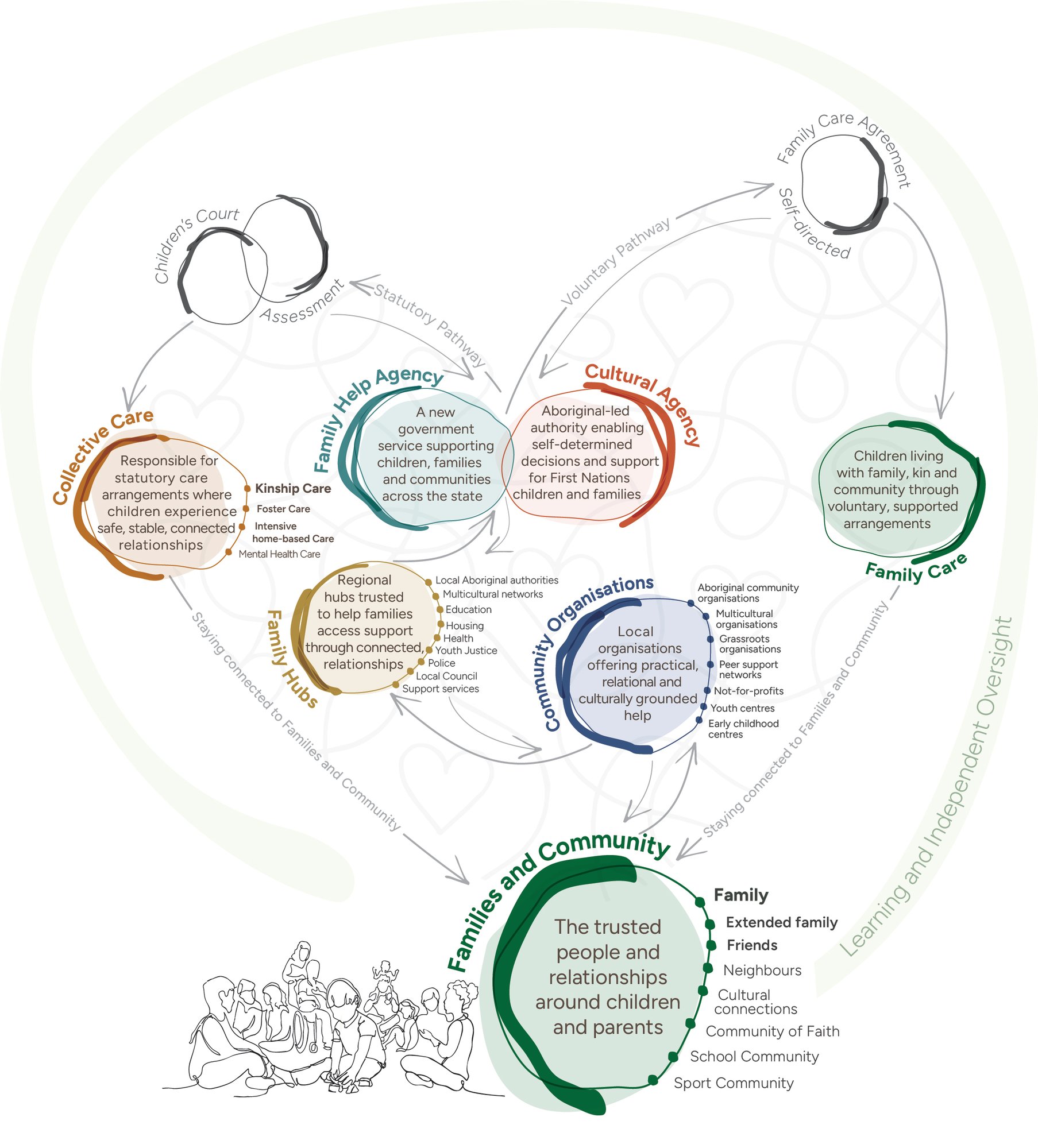
Download a two page PDF of the Child Connection System with explainer.
View an interactive version of the Child Connection System.
Watch a webinar where we walk through the visual, alongside reflections from young people with lived experience about why this work matters.
A Child Connection System creates a healthier ecosystem of support around children and families, so children can grow up safe, secure, loved, and able to thrive within enduring relationships of care and belonging.
The visual brings together many of the shifts already being called for across child and family policy: earlier help, community-led responses, Aboriginal self-determination, prevention-focused funding, learning-oriented oversight, and a workforce with the time, authority and support to work relationally.
It is not a finished blueprint. It’s a practical reference point for change. We’re working alongside others to progress the functional design of areas within the Child Connection System and demonstrate how it can work in practice.
We’d love your reflections, questions and ideas as this work continues: change@centreforrelationalcare.org.au
Why is a Child Connection System a better way to care for kids?

Making it happen
This vision for a Child Connection System is set out in the collaborative report Supporting Children and Families to Flourish, our partnership with the Australian Public Policy Institute.
The report brings existing work together, drawing on policy experts, practitioners, First Nation-led organisations, lived experience and frontline workers. Over 100 research papers and case studies from Australia and beyond provide a strong evidence base for programs and practices that prioritise relationships.
The report tells us what the future could look like but does not deliver us there. The Centre for Relational Care is working alongside people who work in, or are impacted by child protection, in collaborative co-design of this reimagined care system, guided by the wisdom of lived experience.
We are targeting three key drivers of change that everyone in the sector can progress now:
Measure what matters
which is the quality of relationships and lived experience.
Reframe risk
to include the risk of relational deprivation, and not just ‘system’ risks that protect adults and institutions.
Put people over paperwork
keep rules to a sensible minimum, so time goes to children not bureaucracy.
See also our infographic on Humanity over bureaucracy which considers the shifts needed for a Child Connection System. It's a work in progress, and we'd love to hear your thoughts.
If you’d like to be involved or share ideas, please contact us at change@centreforrelationalcare.org.au