
About relational care
What do we mean by relational care?
At the Centre for Relational Care, we’ve had many discussions with people across the care sector about what makes a truly “relational” care system. There are many definitions of what constitutes relational practice, and no single group can have a monopoly on what is or isn't relational.
Notwithstanding this, to help advance a shared understanding of what we mean by a relational care system, here’s our conceptualisation:
- Relationships are at the centre of positive and enduring change for children in care. An essential outcome of relational practice is for all children and young people to have meaningful, enduring, genuine relationships with adults who care about them. This deceptively simple goal is assumed but largely absent in existing professional approaches to care.
- People and organisations who support children, young people, parents and their families, prioritise building positive, sustainable relationships, above all else. The feeling of connection, and being able to adapt to the needs of children and young people in the moment, provides the foundation for effective support.
- The wider system is designed to support relationships as its highest priority. Approaches that prioritise and strengthen relationships are incentivised and measured. Known barriers to building relationships are explicitly named and removed. Where barriers to connection remain – such as staffing issues, funding shortfalls and excessive red tape, we acknowledge the impact this has on child, parent and family wellbeing.
Healing through connection
Children need someone reliable and trusted they can go to when they have a strong need - when something causes them physical or emotional pain. Otherwise, they are left alone in this pain, and they learn that no one else can be trusted. In time, they develop unhealthy ways of coping with this pain, such as social withdrawal, substance use, excessive approval seeking, or engaging in acting out or risk-taking behaviours. We see this all too often in children in statutory care.
A central dilemma of any care system is that children who are removed from family have the greatest need for ‘felt’ safety, while at the same time they struggle the most to recognise or accept care offered to them. This means children in care can be very hard to live with.
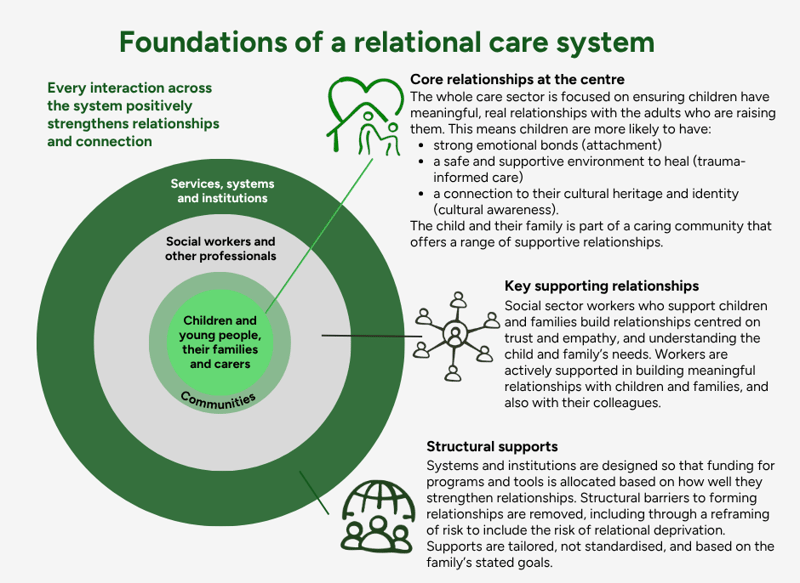
For children in statutory care, whether they are cared for by kin, carers or any other model, the overriding task is therefore to look for, and deeply support, those adults who are willing and able to provide enduring relational security (the centre point in the diagram above). This means offering a child a direct experience of safety - being unconditionally available for children, physically and emotionally, when they most need it. That is, when children feel the most unsafe and are often the hardest to live with.
The National Scientific Council on the Developing Child highlights the role of stable, supportive relationships in building resilience:
"Science shows that children who do well despite serious hardship have had at least one stable and committed relationship with a supportive adult. These relationships buffer children from developmental disruption and help them develop “resilience,” or the set of skills needed to respond to adversity and thrive." See Supportive Relationships and Active Skill-Building Strengthen the Foundations of Resilience, National Scientific Council on the Developing Child (2015)
Context matters
In addition to primary caregivers, a child and their family need positive relationships within their communities, which may include their extended families, sports coaches, teachers, volunteer organisations and so on.
Professional supporting relationships (the middle ring of the diagram above) may include caseworkers, medical and mental health practitioners, and other care service providers.
These extended relationships will differ in terms of boundaries, depth and longevity – which is appropriate and necessary. We need a range of connection-building services in society, and all can be enhanced by an understanding of the centrality of relationships. We need genuine connections between helping adults around the child and family, with boundaries that are informed by the purpose and actions of each service involved.
Healthy versus unhealthy relationships
It can be argued that all interpersonal actions occur in the context of the relationship between those involved. Even avoidant interactions can be understood through a relational lens – for example, we still communicate intent to another person when we choose not to speak with them.
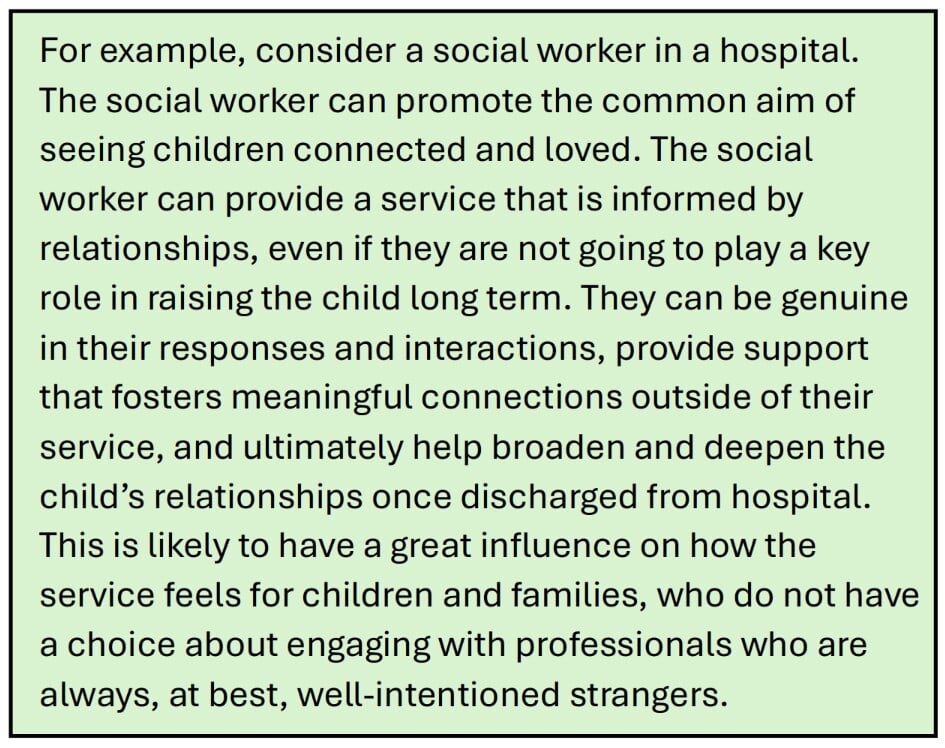
A group home or hotel/motel-style accommodation using shift workers is also using a type of relational practice. But it’s one of anxiety and unpredictability, not one that is aligned with healthy childhood development. When we refer to a relational approach, we mean approaches that promote child-informed, attuned and healthy connections - not simply those that promote having ‘eyes on’ children to provide them with supervision, thereby trying to prevent things from ‘going wrong’.
Relationships that support healthy connections result in children feeling known and cared for. This helps them to build trust and to feel worthy as people. Over time, they are less likely to engage in unhealthy and risky behaviours, because they feel safer and cared for. These positive outcomes not only support children to develop in healthy ways, but also reduce stress on care systems.
What informs relational approaches to care?
Relational care focuses on building positive, trusting relationships between caregivers and children, underpinned by attachment, trauma-informed, and culturally responsive practices.
Attachment
Attachment is about children having the relationships and connections they need to feel safe and secure often enough, and from these experiences, to develop self-worth and build resilience. This sets them up to be able to respond to the challenges of life and to thrive. Caregivers lead the development of these relationships by being sensitive, accepting, responsive, and consistent. If a child is feeling emotional or physical pain (from fear, shame, or injury) their body goes into ‘threat response’. Relationships and connections ensure the child is not alone in this pain. They support the child to move to a place – physically or mentally - where they feel connected, safe, understood, and can be open to new experiences. The nature of these relationships and connections can vary across different cultures. For example, Aboriginal cultures are upheld by a kinship system that extends beyond immediate caregivers, family, and even human relationships, to include the physical environment (Country) and spiritual connections (ancestors), fostering a deep sense of belonging and security from an early age. [1]
Trauma-informed care
Trauma-informed care recognises the impact of trauma on children in out-of-home care. This approach involves creating a relational culture and environment that promotes healing and recovery by considering the child’s past experiences. Trauma-informed care asks what has happened to the child, rather than just what is ‘wrong’ with the child. [2] Caregivers who understand trauma can help build resilience and improve the overall well-being of children in their care.
Culturally responsive care
Culturally responsive care values the diverse backgrounds of children in care. This means caregivers understand and incorporate the cultural, ethnic and religious identities of the children they care for. By doing so, they help children feel more connected to their heritage and identity, which fosters well-being and belonging.
Why is relational practice so important?
There’s a distinction between being friendly and building rapport, versus having a genuine connection. The Centre for Relational Care is guided by people with extensive experience in the care sector, including psychologists, social workers and care providers who engage with the sector every day. They tell us that children and families feel this difference profoundly.
Children are only able to engage, adapt and heal when they have a meaningful relationship with the adults trying to help them do so. Psychology refers to this as ‘connecting’ before ‘correcting’. [3] Beyond the professional lens, any parent of a child or helping adult who was once a child (all of us) knows this to be true. The challenge is translating this simple truth into a care system whose well-meaning intentions too often isolate children from the genuine connection they need.
Real relationships are messy, particularly when connected with wounded children, burdened families and overwhelmed professionals. A relational approach encourages the care system to acknowledge and work with this messiness – making space for emotion, genuine connection and trust - rather than deny or contain it through procedures and transactional approaches.
On a wider scale, the evidence for the critical role of relationships in individual and societal health and wellbeing is extensive and growing. Here are recent examples:
- The 85-year Harvard Study of Adult Development - the longest running scientific study of adult life ever conducted - found that “the people who stayed healthiest and lived longest were the people who had the strongest connections to others.” Read more
- The US Surgeon General reported on an “epidemic of loneliness and isolation” as an urgent public health issue. He points to scientific evidence showing that loneliness is associated with a greater risk of cardiovascular disease, dementia, stroke, depression, anxiety, and premature death. Turning this around “will require reimagining the structures, policies, and programs that shape a community to best support the development of healthy relationships.” Read the report
Download a PDF version of What do we mean by Relational Care?
[1] Kingsley, J., Townsend, M., Henderson-Wilson, C., & Bolam, B. (2013). Developing an exploratory framework linking Australian Aboriginal peoples’ connection to country and concepts of wellbeing. International Journal of Environmental Research and Public Health, 10), 678–698. https://doi.org/10.3390/ijerph10020678 cited in Wright, A., Gray, P., Selkirk, B., Hunt, C., & Wright, R. (2024). Attachment and the (mis)apprehension of Aboriginal children: epistemic violence in child welfare interventions. Psychiatry, Psychology and Law, 1–25.
https://doi.org/10.1080/13218719.2023.2280537
[2] Bloom, S. L. & Farragher, B. (2011) Destroying Sanctuary: The Crisis in Human Service Delivery Systems, New York: Oxford University Press)
[3] Golding, K. S., & Hughes, D. A. (2012). Creating Loving Attachments: Parenting with PACE to Nurture Confidence and Security in the Troubled Child, Jessica Kingsley Publishers
[1] Kingsley, J., Townsend, M., Henderson-Wilson, C., & Bolam, B. (2013). Developing an exploratory framework linking Australian Aboriginal peoples’ connection to country and concepts of wellbeing. International Journal of Environmental Research and Public Health, 10), 678–698. https://doi.org/10.3390/ijerph10020678 cited in Wright, A., Gray, P., Selkirk, B., Hunt, C., & Wright, R. (2024). Attachment and the (mis)apprehension of Aboriginal children: epistemic violence in child welfare interventions. Psychiatry, Psychology and Law, 1–25. https://doi.org/10.1080/13218719.2023.2280537
[2] Bloom, S. L. & Farragher, B. (2011) Destroying Sanctuary: The Crisis in Human Service Delivery Systems, New York: Oxford University Press).